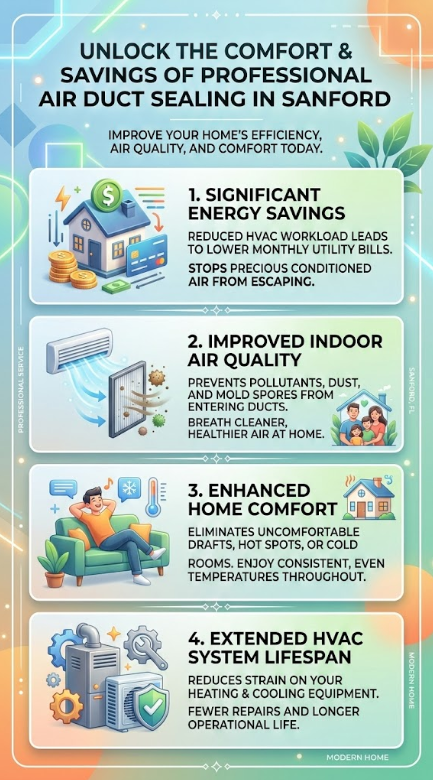
Most Sanford homeowners don't realize their ducts are bleeding money — until they see the difference after sealing. The average home loses 20–30% of its conditioned air through duct leaks, but in Central Florida's punishing heat and humidity, that number climbs even higher in older Sanford homes with ductwork routed through unconditioned attics.
After sealing thousands of duct systems across the Sanford area, our technicians have found that homeowners typically notice two things within the first week: rooms that never cooled properly finally feel comfortable, and the AC stops running constantly. That's not a sales pitch — it's what happens when conditioned air actually reaches the rooms it's supposed to.
Here's what you need to know about how professional air duct sealing in Sanford works, why Sanford's climate makes it essential, and the measurable savings our customers see after service.
TL;DR Quick Answers
Air Duct Sealing in Sanford
Air duct sealing in Sanford is the process of locating and closing gaps, cracks, and disconnections in your home's ductwork to stop conditioned air from escaping into unconditioned spaces like your attic. Most Sanford homes lose far more cooled air than their owners realize — the national average is 20–30%, but homes with aging attic-routed ductwork in Central Florida's extreme heat often exceed that range.
Why it matters in Sanford specifically:
Summer attic temperatures exceed 140°F, turning leaky ducts into a major energy drain
Gaps in ductwork pull hot, humid attic air and contaminants into your living spaces
Most comfort complaints — warm rooms, constant AC cycling, stubborn humidity — trace back to duct leaks, not equipment failure
What to expect from professional duct sealing:
A pressure test identifies exactly how much air your system is losing and where
Sealing typically takes four to eight hours with no major disruption to your household
Homeowners notice improved comfort, lower energy bills, and better air quality within days
Our experience-based recommendation: Have your ducts pressure tested before investing in any other HVAC upgrade. After sealing thousands of systems across Sanford, we've found it consistently delivers the highest return on investment of any comfort improvement available — and it should always come before equipment replacement decisions.
Top Takeaways
Leaky ducts are likely costing you more than you think. The national average is 20–30% conditioned air loss. In Sanford homes with aging attic-routed ductwork, our technicians routinely find losses that exceed that range.
Your AC probably isn't the problem. Your ducts are. Most comfort complaints we respond to in Sanford — hot rooms, constant cycling, stubborn humidity — trace back to duct leaks, not equipment failure. Sealing ducts first often eliminates what homeowners assumed required a full system replacement.
Attic ductwork in Florida's climate works against you every day. Summer attic temperatures exceed 140°F. Ducts routed through that space lose 25–40% of their energy before cooled air reaches your rooms. Sealing those ducts is one of the most cost-effective upgrades available.
Duct leaks are a health issue, not just an energy issue. Gaps in ductwork pull insulation particles, dust, mold spores, and humid attic air directly into your family's airstream. Customers tell us they notice less dust and fewer allergy symptoms within days of sealing.
Test your ducts before you upgrade anything else. A professional pressure test takes less than an hour. It tells you exactly how much air you're losing and where. In our experience, it's the single most valuable first step a Sanford homeowner can take.
Why Duct Leaks Are a Bigger Problem in Sanford Than Most People Think
Sanford sits in one of the most demanding HVAC climates in the country. With summer heat indexes regularly pushing past 105°F and humidity levels that hover around 70–80%, your air conditioning isn't a luxury — it's a lifeline. When ducts leak, your system fights a losing battle against Central Florida's climate, pulling in hot attic air and moisture through every gap and loose connection.
What makes Sanford homes particularly vulnerable is age and construction style. Many homes in historic downtown Sanford and surrounding neighborhoods were built with ductwork running through vented attics where temperatures can exceed 140°F in summer. Even newer developments off Rinehart Road and around Riverwalk aren't immune — builder-grade duct connections loosen over time, and Florida's temperature swings accelerate that wear.
Lower Energy Bills Without Replacing Your System
One of the first things homeowners notice after professional duct sealing is a drop in their energy bill — often 15–25% in the first billing cycle. That's not because the AC unit suddenly got more efficient. It's because conditioned air is finally reaching every room instead of escaping into the attic or crawl space.
We've worked on homes where the system was running nearly nonstop and the owner was convinced they needed a full replacement. After sealing, the existing unit handled the load comfortably. That's a repair measured in hundreds of dollars versus a replacement costing thousands.
More Consistent Temperatures Room to Room
If you've ever had a bedroom that stays warm no matter how low you set the thermostat, leaky ducts are almost always the reason. Gaps in the supply lines starve certain rooms of airflow while others get too much. Professional sealing restores balanced distribution so every room reaches the temperature you set.
In our experience with Sanford homes, the rooms furthest from the air handler — typically back bedrooms and bonus rooms over garages — show the most dramatic improvement after sealing.
Better Indoor Air Quality for Your Family
Leaky ducts don't just let conditioned air out — they pull contaminants in. Dust, insulation fibers, pollen, and mold spores from attic spaces get drawn into the airflow and circulated throughout your home. In a climate as humid as Sanford's, moisture intrusion through duct leaks also creates conditions where mold thrives inside the ductwork itself.
Sealing eliminates those entry points. Homeowners with allergy and asthma concerns consistently report noticeable relief after service, especially during Sanford's spring pollen season and the high-humidity months of July through September.
Less Strain on Your HVAC System Means Fewer Repairs
When your system has to compensate for lost airflow, every component works harder — the compressor cycles more frequently, the blower motor runs longer, and refrigerant pressure fluctuates beyond normal ranges. Over time, this accelerated wear leads to breakdowns that could have been avoided.
Professional duct sealing reduces that stress. We routinely see customers go from multiple service calls a year to predictable, low-maintenance operation simply because the system is no longer overworking to meet thermostat demand.
What the Professional Sealing Process Actually Looks Like
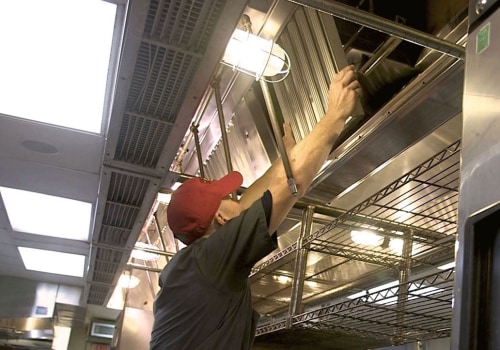
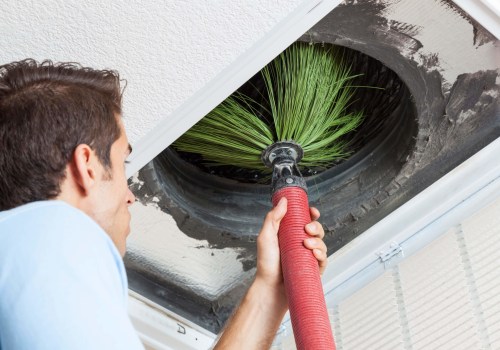
A proper duct sealing job starts with a thorough inspection — our technicians pressurize the system and use diagnostic tools to locate every leak, not just the obvious ones. From there, we apply commercial-grade mastic sealant and reinforced closures to each connection point, joint, and penetration.
The process typically takes a few hours for an average Sanford home and doesn't require any major demolition or disruption. Most homeowners are surprised at how straightforward it is — and how quickly they feel the results once the system kicks back on.
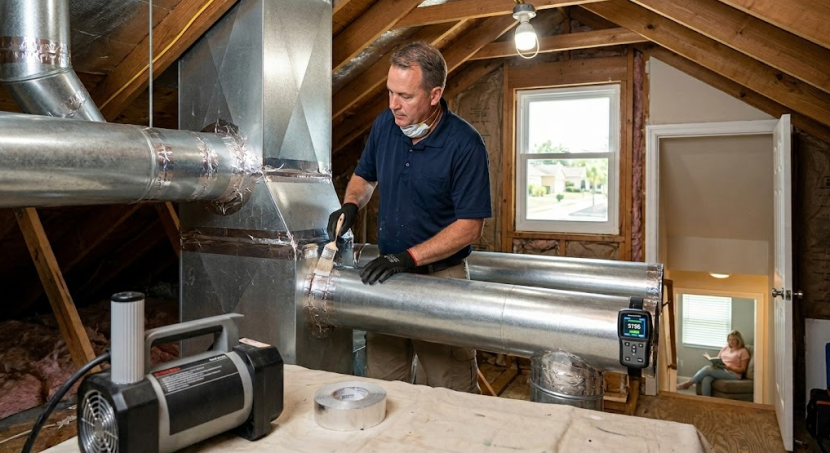
"In most Sanford homes we service, the biggest energy problem isn't the AC unit — it's the ductwork nobody ever looks at. Once we seal those hidden leaks, homeowners are always surprised at how much cooler and quieter their home feels almost overnight."
Essential Resources on Air Duct Sealing in Sanford
We tell every Sanford homeowner the same thing before they schedule duct sealing: do your homework first. The more you understand about how duct leaks affect your home, your energy bills, and your family's air quality, the better equipped you'll be to make a decision you feel good about — whether you hire us or someone else. These seven trusted resources are the same ones our technicians reference, and they'll give you the foundation you need to move forward with confidence.
1. Understand How Much Energy Leaky Ducts Are Costing You
Source: ENERGY STAR — Benefits of Duct Sealing
URL: https://www.energystar.gov/saveathome/heating-cooling/duct-sealing/benefits
We've seen it hundreds of times across Sanford — homeowners shocked to learn their ductwork is bleeding up to 20% of the air they're paying to cool. ENERGY STAR's duct sealing overview breaks down exactly why this happens and how sealing those leaks often pays for itself through lower utility bills. If you've noticed certain rooms never feel right no matter what you set the thermostat to, start here.
2. Learn the Science Behind Duct Energy Loss and Insulation
Source: U.S. Department of Energy — Minimizing Energy Losses in Ducts
URL: https://www.energy.gov/energysaver/minimizing-energy-losses-ducts
The DOE explains where duct leaks typically occur and why insulating ducts in unconditioned spaces is one of the most cost-effective upgrades available. This matters especially here in Sanford, where we routinely find ductwork routed through sweltering attics — sometimes with connections that were never properly sealed during original construction. This resource helps you understand the mechanics behind the problem before you talk to any contractor.
3. Know How Duct Leaks Affect Your Family's Indoor Air Quality
Source: U.S. EPA — Should You Have the Air Ducts in Your Home Cleaned?
URL: https://www.epa.gov/indoor-air-quality-iaq/should-you-have-air-ducts-your-home-cleaned
This is one we take personally. The EPA outlines how gaps in ductwork pull dust, allergens, mold spores, and humidity into your living spaces — and in Central Florida's climate, that's not a hypothetical concern. Customers tell us they didn't realize their stuffy, humid-feeling rooms weren't an AC problem at all. They were a duct problem. This guide helps you determine when sealing, cleaning, or both are warranted for your home's health.
4. Understand What Florida Law Requires for Duct Sealing
Source: Florida Building Code, Energy Conservation, 8th Edition (2023)
URL: https://www.floridabuilding.org
Here's something most Sanford homeowners don't know: Florida's energy code mandates that all duct systems be sealed and tested to verified tightness standards, and requires duct inspection and sealing whenever HVAC equipment is fully replaced. In our experience, not every contractor follows through on this. Knowing these requirements protects you from shortcuts and ensures your duct sealing project meets state law — not just a technician's best guess.
5. Verify Your Contractor Follows National Duct Design Standards
Source: ACCA Manual D — Residential Duct Systems
URL: https://www.acca.org/standards/technical-manuals/manual-d
We follow ACCA Manual D standards on every job because proper duct sealing starts with understanding how the system was designed to move air. The Air Conditioning Contractors of America publishes this nationally recognized standard for duct design, sizing, and performance. Before you hire anyone — including us — ask whether they follow ACCA standards. It's one of the most reliable ways to separate qualified professionals from those winging it.
6. Find Florida Rebates and Incentives to Offset Your Cost
Source: My Florida Home Energy — Incentives for Energy Efficiency Upgrades
URL: https://www.myfloridahomeenergy.com/help/library/financing-incentives/incentives/
One thing we always remind Sanford families: don't leave money on the table. This state-maintained database helps you identify utility rebates, energy efficiency loans, and manufacturer incentives that can significantly reduce your out-of-pocket cost. Most Florida utilities offer specific rebates for ductwork sealing performed by licensed professionals, and our team can help you determine which programs apply to your situation.
7. Claim Federal Tax Credits for Qualifying HVAC and Duct Improvements
Source: IRS — Energy Efficient Home Improvement Credit (Section 25C)
URL: https://www.irs.gov/credits-deductions/energy-efficient-home-improvement-credit
The federal Energy Efficient Home Improvement Credit allowed homeowners to claim up to $3,200 for qualifying energy efficiency upgrades completed through December 31, 2025. If you had eligible HVAC or duct-related work done before that deadline, you can still claim this credit when filing your 2025 return using IRS Form 5695. We encourage every customer to check eligibility — the savings add up.
Supporting Statistics: What the Numbers Say About Duct Sealing in Sanford
These aren't statistics we pulled from a textbook. They're the same figures our technicians reference in the field — and after sealing thousands of duct systems across Sanford, the real-world numbers often look worse than what the research reports.
20–30% of Conditioned Air Lost Through Duct Leaks
ENERGY STAR reports that the average home loses 20 to 30 percent of its conditioned air through duct leaks, holes, and poorly connected joints. That's the national benchmark. In our experience servicing Sanford homes, actual losses frequently exceed that range.
Why Sanford homes trend higher:
Many duct systems were installed decades ago without mastic sealant
Years of Central Florida heat cycles cause connections to loosen and gaps to widen
Damage accumulates in places homeowners never see — above the ceiling, behind walls
The thermostat says 72. The energy bill says otherwise. The answer is almost always hiding in the ductwork.
Source: ENERGY STAR — Duct Sealing Fact Sheet (U.S. EPA / U.S. DOE) https://www.energystar.gov/sites/default/files/asset/document/ES_Duct_Sealing_flyer.pdf
25–40% Energy Loss From Attic and Crawlspace Ductwork
The National Renewable Energy Laboratory confirms what we've observed on thousands of service calls: ducts routed through unconditioned attics and crawlspaces lose 25 to 40 percent of heating and cooling energy before it reaches your living spaces.
Why this hits Sanford homes especially hard:
The vast majority of Sanford residences have attic-routed ductwork
Summer attic temperatures routinely exceed 140°F
Your system is essentially pushing cooled air through an oven
What homeowners tell us after sealing:
Rooms that ran warm for years suddenly hold temperature
The AC finally stops running nonstop
Comfort improves before they ever read the research
Source: NREL / U.S. Department of Energy — Better Duct Systems for Home Heating and Cooling https://docs.nrel.gov/docs/fy05osti/30506.pdf
Indoor Air 2–5x More Polluted Than Outdoor Air
The U.S. EPA reports that indoor pollutant concentrations are often two to five times higher than outdoor levels — and can occasionally exceed 100 times outdoor concentrations. Leaky ductwork is one of the biggest contributors to this problem, and it's something we bring up on nearly every Sanford service call.
What leaky return ducts pull into your airstream:
Insulation particles and dust from the attic
Mold spores thriving in Florida's humidity
Unconditioned hot, humid air that overworks your system
What customers notice after sealing:
Less dust settling on furniture and surfaces
Fewer allergy flare-ups within the first week
A noticeable difference in how the home smells and feels
The EPA's research explains the science. Families living with the improvement don't need a study to confirm what they're feeling.
Source: U.S. EPA — Indoor Air Quality https://www.epa.gov/report-environment/indoor-air-quality
Final Thought: Why We Believe Duct Sealing Is the Most Undervalued Home Upgrade in Sanford
After years of servicing homes across Sanford and Central Florida, we've come to a simple conclusion: duct sealing delivers more noticeable, immediate improvement to home comfort than almost any other HVAC service we offer. Yet it's consistently the last thing homeowners think to ask about.
That disconnect shows up every week. A family calls about a spiking energy bill. Another calls because the back bedrooms never cool down. Someone else is convinced their AC is failing. In the majority of these cases, the equipment is fine. The ducts are the problem.
Here's what bothers us about our own industry.
Too many HVAC companies steer homeowners toward full system replacements when the real issue is leaking ductwork that was never properly sealed. A new $8,000 AC unit connected to ducts hemorrhaging 30% of their output into the attic is still an underperforming system.
We've seen it firsthand. Brand-new equipment delivered disappointing results because nobody addressed the ducts first. That's not a technology problem. That's a priority problem.
Our honest take on duct sealing in Sanford specifically:
Most homes here were built with ductwork routed through unconditioned attics — a design choice that works against you in Florida's climate every single day
Extreme heat, high humidity, and aging materials mean Sanford duct systems deteriorate faster than national averages suggest
Homeowners who seal their ducts before upgrading equipment almost always end up needing a smaller, less expensive system — because the ducts can finally deliver what the equipment produces
If we could give every Sanford homeowner one piece of advice:
Have your ducts tested. Not inspected. Tested.
A proper pressure test takes less than an hour and tells you exactly how much air you're losing and where. Everything else should follow from that number.
The federal data backs this up. ENERGY STAR, the Department of Energy, NREL, and the EPA all point to duct sealing as one of the most cost-effective energy improvements available.
But you don't need their reports to understand the impact. You just need to stand in a room that never felt right, have the ducts sealed, and feel the difference the next morning.
That's not a statistic. That's a Tuesday for our team.
FAQ on Air Duct Sealing in Sanford
Q: How do I know if my Sanford home needs duct sealing?
A: Don't guess. Test. But these warning signs should prompt the call:
A room that never feels right no matter what you set the thermostat to
Humidity that lingers indoors even though the AC hasn't stopped running
Energy bills climbing without explanation
Excessive dust returning within days of cleaning
The most telling sign we encounter in Sanford isn't high energy bills. It's the room that every home seems to have — the one that stays warm no matter what you do. Homeowners live with it for years assuming that's just how their house is. It's not.
A professional pressure test takes less than an hour and gives you a definitive answer instead of another theory.
Q: How much does professional duct sealing cost in Sanford?
A: We'd rather be straight with you than give a generic number that doesn't apply to your home. Cost depends on three variables:
Size of your duct system
Accessibility of the ductwork
Severity of the leakage
Those factors differ from house to house in Sanford. What we can tell you from experience:
Most homeowners recoup the investment through energy savings within one to three years
Homeowners who seal ducts before replacing equipment frequently discover they can downsize to a smaller, less expensive AC system
We've watched families save thousands on equipment costs simply because they addressed the ducts first
A pressure test gives you the real numbers to make that calculation for your specific home.
Q: What's the difference between duct sealing and duct cleaning?
A: We get this question on nearly every service call. They solve different problems entirely:
Duct cleaning removes what's accumulated inside the ducts — dust, debris, allergens
Duct sealing closes the structural gaps, cracks, and disconnections that allow conditioned air to escape and attic air to infiltrate your system
Here's why sealing matters more in most cases. You can clean ducts spotless, but if the system has a three-inch gap at a trunk line connection in the attic, you're still losing conditioned air and pulling in contaminants 24 hours later.
Our recommendation:
Seal first — address the root cause
Clean second — but only if significant contamination is found during the sealing process
Never clean without sealing — it treats symptoms while the underlying problem continues
In our years servicing Sanford homes, sealing has consistently delivered a far greater impact on comfort and energy savings than cleaning alone.
Q: How long does duct sealing take, and will it disrupt my household?
A: Most Sanford homes take four to eight hours depending on system size and severity of leakage. The process is minimally invasive:
Technicians work primarily at attic access points and register connections
No tearing into walls or ceilings
You don't need to leave the house
Your system is typically back up and running the same day
What surprises most homeowners is how quickly the results show up:
The house feels different that evening
Rooms that always ran warm hold temperature
The AC cycles down instead of running constantly
The air feels less stuffy and more consistent
One Sanford homeowner told us recently that she didn't realize how hard her system had been working until it finally got quiet. That's the kind of feedback we hear repeatedly.
Q: Why is duct sealing especially important for homes in Sanford and Central Florida?
A: Two factors that compound each other in this climate — extreme heat and relentless humidity.
What's happening inside your attic:
Most Sanford homes have ductwork routed through unconditioned attic space
Summer attic temperatures regularly exceed 140°F
Leaky ducts lose cooled air into that superheated space
Those same leaks pull hot, moisture-laden attic air into your family's airstream
The cascading effect on your home:
Your AC fights a battle it cannot win
It runs harder, runs longer, and wears out faster
Rooms still feel warm and humid despite constant cycling
Equipment lifespan shortens and repair frequency increases
In a northern climate with mild summers, leaky ducts are a nuisance. In Sanford, they're an accelerant — making every other HVAC problem worse than it needs to be.
That's why our technicians consider duct sealing the foundation of every comfort improvement we recommend. Fix the delivery system first. Everything else performs better after that.
Ready to Experience the Benefits of Professional Air Duct Sealing in Your Sanford Home?
Schedule a duct pressure test today and find out exactly how much conditioned air your system is losing — and how much comfort and savings are waiting on the other side. Our Sanford technicians are ready to show you the difference properly sealed ductwork makes from day one.
Here is the nearest branch location serving the Pembroke Pines FL area…
Filterbuy HVAC Solutions - Weston FL
2573 Mayfair Ln, Weston, FL 33327, United States
(754) 296-3528